
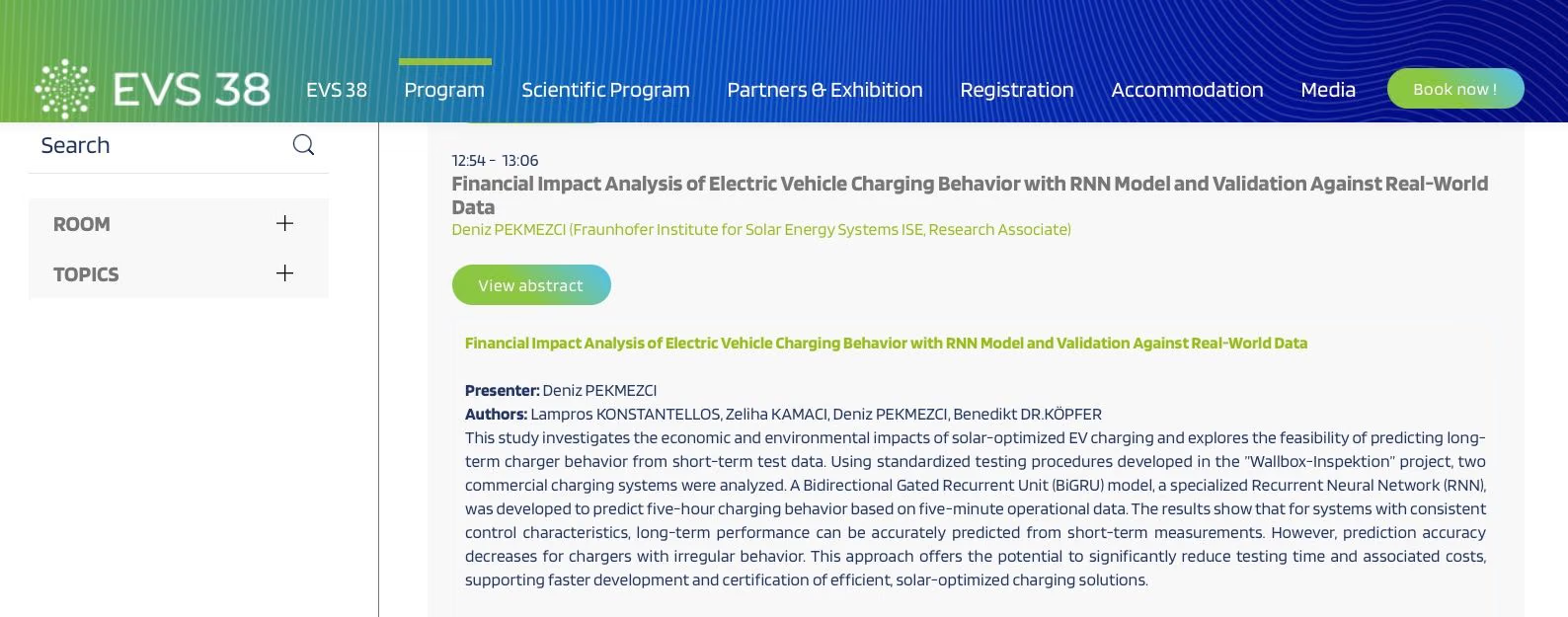
From 15–18 June 2025, the 38th International Electric Vehicle Symposium & Exhibition (EVS38) took place in Gothenburg, Sweden. Our paper, "Financial Impact Analysis of Electric Vehicle Charging Behavior with RNN Model and Validation Against Real-World Data", was presented there by my co-author Deniz Pekmezci. As first author, I developed this work during my internship at the Fraunhofer Institute for Solar Energy Systems ISE.
The study addresses a practical question for the EV charging industry: can the long-term behaviour of a charger be predicted from only short-term test data? The answer matters, because it determines how much testing a charger needs before it can be trusted in the field, and how well it can be matched to solar-optimised, smart-charging operation.
To answer it, we used BiGRU-based recurrent neural networks, trained on short-term measurements and validated against real-world data. The models predicted long-term charging behaviour with a prediction error as low as 4.9% for high-performing chargers. Accuracy was strongest for chargers with consistent control logic and weaker for those with more irregular behaviour, pointing to a clear conclusion: a charger's own control design shapes how predictable it is.
What the approach enables:
- Predicting long-term charger behaviour from short-term test data
- Optimising solar-based smart charging systems
- Reducing testing costs and accelerating product validation
- Improving energy efficiency and environmental impact
Many thanks to my co-authors Zeliha Kamacı, Deniz Pekmezci, and Dr. Benedikt Köpfer for the collaboration. The work was carried out at Fraunhofer ISE and is openly available in the EVS38 proceedings and on Zenodo.
More broadly, the study reflects a direction I find compelling: using data-driven methods to make EV charging both cheaper to validate and better integrated with renewable generation, so that the more consistent a charger's control logic is, the more reliably short-term data can stand in for the long term.