
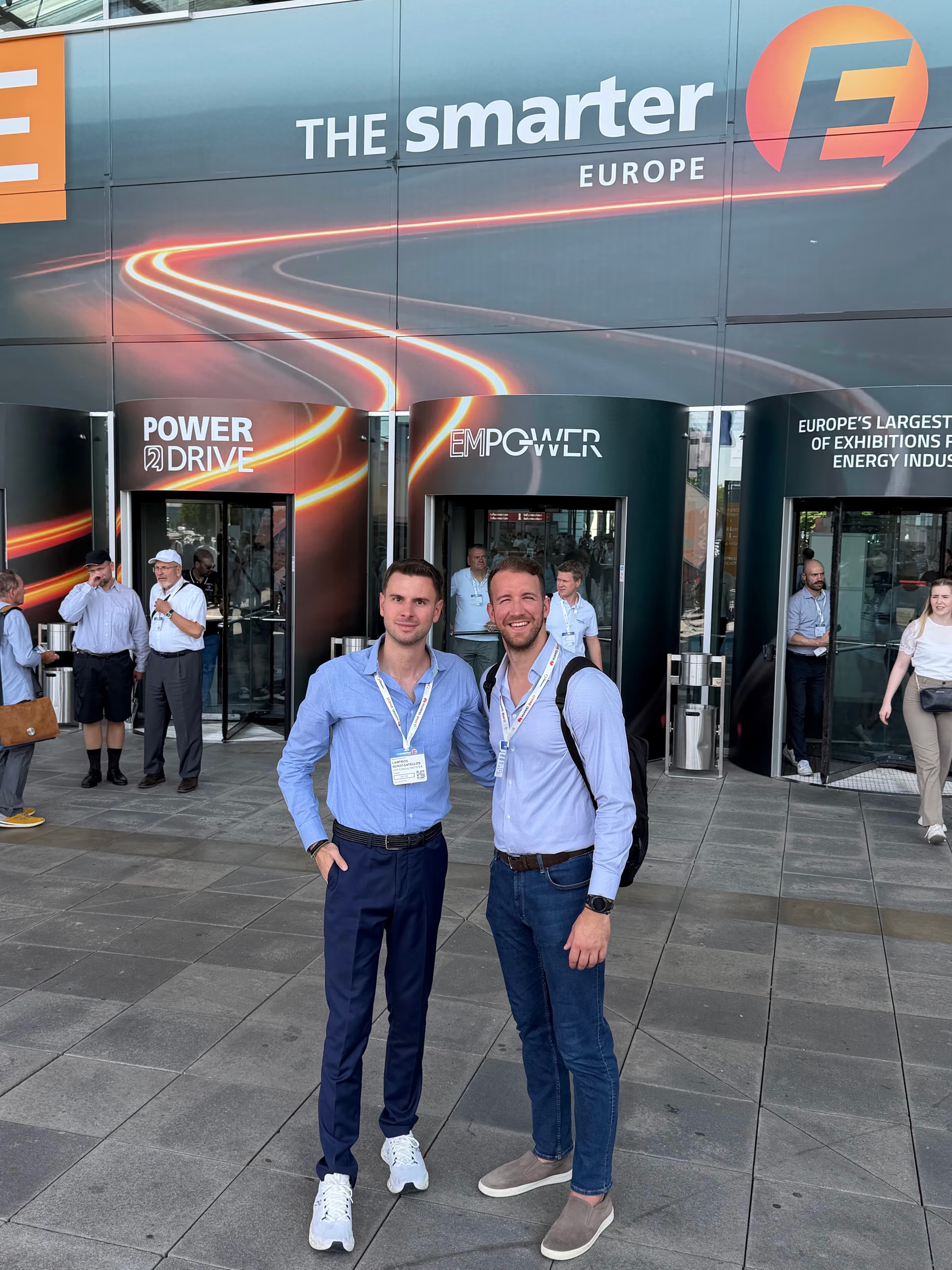
From 23–25 June 2026, I attended Intersolar Europe and the wider The smarter E Europe in Munich, the umbrella event that brings together four co-located exhibitions: Intersolar Europe for solar, ees Europe for energy storage, Power2Drive Europe for charging infrastructure and e-mobility, and EM-Power Europe for energy management. According to the organisers, the event gathered around 105,000 trade visitors from 163 countries and 2,650 exhibitors from 52 countries, under the theme "Renewables 24/7: Secure Energy for a Changing World".
What stood out to me most is that the industry has moved its centre of gravity. A few years ago, the defining question was how much photovoltaic capacity could be added. In Munich, the defining question was different: how to integrate, dispatch, and extract value from that capacity once it is on the system. The four exhibitions were no longer four separate worlds, but one system of generation, storage, charging, and software.
Key points I took from Munich:
- Battery storage has shifted from backup to a revenue-generating asset class. The discussion focused on revenue stacking across energy arbitrage, ancillary services, and capacity, and on the dispatch strategy and forecasting quality that determine whether a project actually performs.
- Hybrid PV plus storage is becoming the default plant architecture. Co-locating batteries with PV was presented less as an option and more as a precondition for long-term project viability and stable revenues in increasingly volatile markets.
- Grid-forming inverters moved firmly into the mainstream. Beyond simple power conversion, inverters are now expected to provide system inertia, voltage and frequency support, and black-start capability, helping to maintain grid stability as conventional generation retires.
- Software and energy management are where differentiation is moving. Energy management systems, AI-based forecasting, optimisation engines, and virtual power plants were central across the halls, as hardware faces growing price pressure and the operating intelligence becomes the real differentiator.
- Charging is becoming bidirectional and grid-interactive. The focus at Power2Drive was on bidirectional, megawatt, and smart charging, with electric vehicles increasingly treated as flexible energy assets rather than passive loads.
- Curtailment and negative prices are now a structural, pan-European issue. Once associated mainly with a few markets, curtailment and zero or negative wholesale prices have become a shared European concern, reframing storage and flexibility as the response, rather than larger inverters or more capacity.
For Greece, these themes are immediate rather than distant. Curtailment of renewable generation reached 1,867 GWh in 2025, equivalent to 6.6% of total renewable generation and more than double the level of 2024, with research pointing to a further increase toward 3.3 to 3.7 TWh in 2026. Midday wholesale prices regularly fall to zero or below. This is precisely the environment in which the combination of PV, storage, and intelligent energy management creates value, by shifting production, increasing self-consumption, and converting an otherwise curtailed surplus into a dispatchable resource. With a 4.7 GW utility-scale storage programme underway and the net-billing framework shaping prosumer investments, the Greek market sits exactly at the intersection that Munich was built around, provided that grid connection can keep pace.
My main takeaway is that the value of a renewable project is no longer defined only by how much it can generate, but by how intelligently it can be operated within a constrained and increasingly dynamic power system. The most interesting projects I saw in Munich were not the largest, but the best integrated.